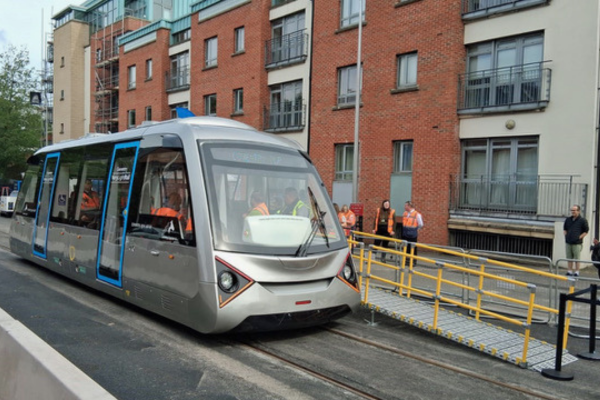
When people ask what I do and I respond with ‘I work in the global Light Rail industry’, I often get the response ‘that’s quaint’ as it conjures the image of some nice old tram pottering along a track in a black and white photograph. Do you get a similar response?
It couldn’t be further from the truth. The Global Light Rail market (Light Rails and metro systems) have doubled since the 1980’s and is forecast to continue to grow. At the end of 2025 the market will have an annual operating revenue in excess of £330bn. The next 5 years will see over £300bn invested in new systems, new lines and new extensions (and that doesn’t include maintenance and improvement of existing infrastructure and rolling stock). The result will be a market with an annual operating cost of over £400bn by 2031 – which makes it one of the top 20-25 global marketplaces.
So how does this growth manifest itself. We track every system and line across the globe from proposed through construction to operational. In terms of proposed we only include those where a business case or active authority engagement is involved. When we apply this, we see an 8% increase in Light Rail systems and a further 15% increase in the length of existing systems with new lines and extensions equating to 200 more lines and extensions. The picture is similar for metro systems with an increase of 9% in systems coupled with 22% increase in the length of existing systems with new lines and extensions delivered through an additional 240 new lines and extensions.
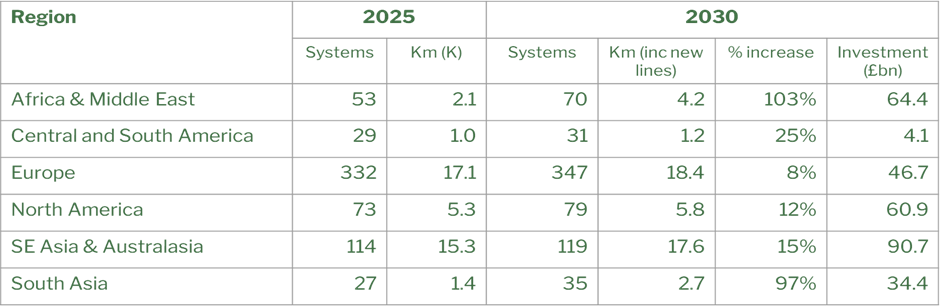
When we look across the globe, other than in South America, there is a consistent level of growth and investment (although watch out for new systems in Uruguay, Brazil and Salvador). In South-East Asia the next 5 years will see an investment of over £90bn with a 15% increase in the total length of track. Whilst dominated by China the region is seeing lots of development across numerous other countries. In South Korea there is development across several systems and not just limited to the Seoul Metropolitan Subway, with a new system proposed in Hwaseong, and system extensions in Busan, Daejeon and Gwangju. Singapore is extending the MRT, developing the Johor Bahru–Singapore Rapid Transit System which will cross the border between Singapore and Malaysia and Thailand is extending the Bangkok MRT.
Of the £35bn investment forecast for South Asisa, India accounts for 65% of the investment with an additional 52 metro lines. However, this does not include the 19 Metro Lite systems proposed across India, which will provide them with the ability to extend metro systems at reduced cost (an estimated development cost of £10.bn).
Moving over to the Middle East there is significant investment (over £60bn) with new systems in Saudi Arabia, UAE and Egypt coupled with some small growth in Africa in Iraq, Egypt, Angola and Nigeria.
North America is forecast to invest over £60bn, however this is reflective of extensive development in Canada where the Eglinton Cross Town LRT is under construction, coupled with significant extension of the existing systems in Ottowa, Vancouver, Montreal, Toronto and Calgary.
And finally, to Europe. Whilst growth is forecast at 8% it is on the foundation of the largest number of existing systems and length of track. There still is, however, significant scope for growth. In the UK we are potentially seeing two new systems. The first in Leeds, which until built will remain the largest city ion Europe without a Light Rail system, and the second is in Coventry which could readily become a blueprint global game changer with the introduction of the highly innovative Very Light Rail (VLR) solution. And elsewhere in Europe we will see new systems in Italy, Switzerland, Finland and Serbia.
Is it surprising to see this growth? Hardly. The level of urbanization will continue to grow (by about 3% points over the period) and, coupled with the climate pressures, the need for effective and efficient mass transport will increase.
The effective integration and use of light rail and metro system must be a fundamental building block of the SMART cities of the future. Today there is a significant uptapped or un-serviced populations that needs such systems. In the UK alone, there are 55 towns and cities with a population of over 150k, which by 2050 will have increased to 66, and yet currently only 21 of those cities/towns have a system or have one in the planning process.
We hear that the reticence against adoption is primarily a matter of cost and funding, and yet the Phillipines, with an average GDP per capita of $10,400 and ranked 143rd in the world, is currently investing in $7bn to build the phased Manila Metro which, upon completion, will be over 33km in length and service the 15m population of the Manila metro area. So is it the perception and the time taken that isn’t in line with the political landscape? Why would a politician push for this solution when in all likeliness there will be an election before completion of the system? The ability to share learning, data and innovation creates a platform will readily reduce time and cost – and create platform that can connect the public and private sector.
So when asked ‘what do you do’ the answer becomes ‘I work in the Global Light Rail market – a £300bn market that is growing and will continue to grow as it’s the best, environmentally friendly way to get around our growing towns and cities’ and when I hear we can’t afford to build them the answer is ‘’can we afford not to?’’.